Resource Planning for Agencies: A Simple Weekly System
Resource planning doesn't need a new tool. It needs one honest capacity number per person and a 30-minute meeting every week. Here's the system.
 Paul · · 3 min read

Resource planning in an agency means knowing, a week ahead, who is free, who is overbooked, and which work is at risk. You don't need an expensive tool to do it. You need an honest capacity number for each person, a rule for how full to book them, and a short weekly meeting where the plan gets decided.
In Productive's 2025 Agency Industry Report, 52% of agencies allocated resources four weeks or less before work began, and 46% of growing agencies still operated week to week. Short-notice planning is normal. Unplanned planning is the problem.
Step 1: Work out real capacity, not contracted hours
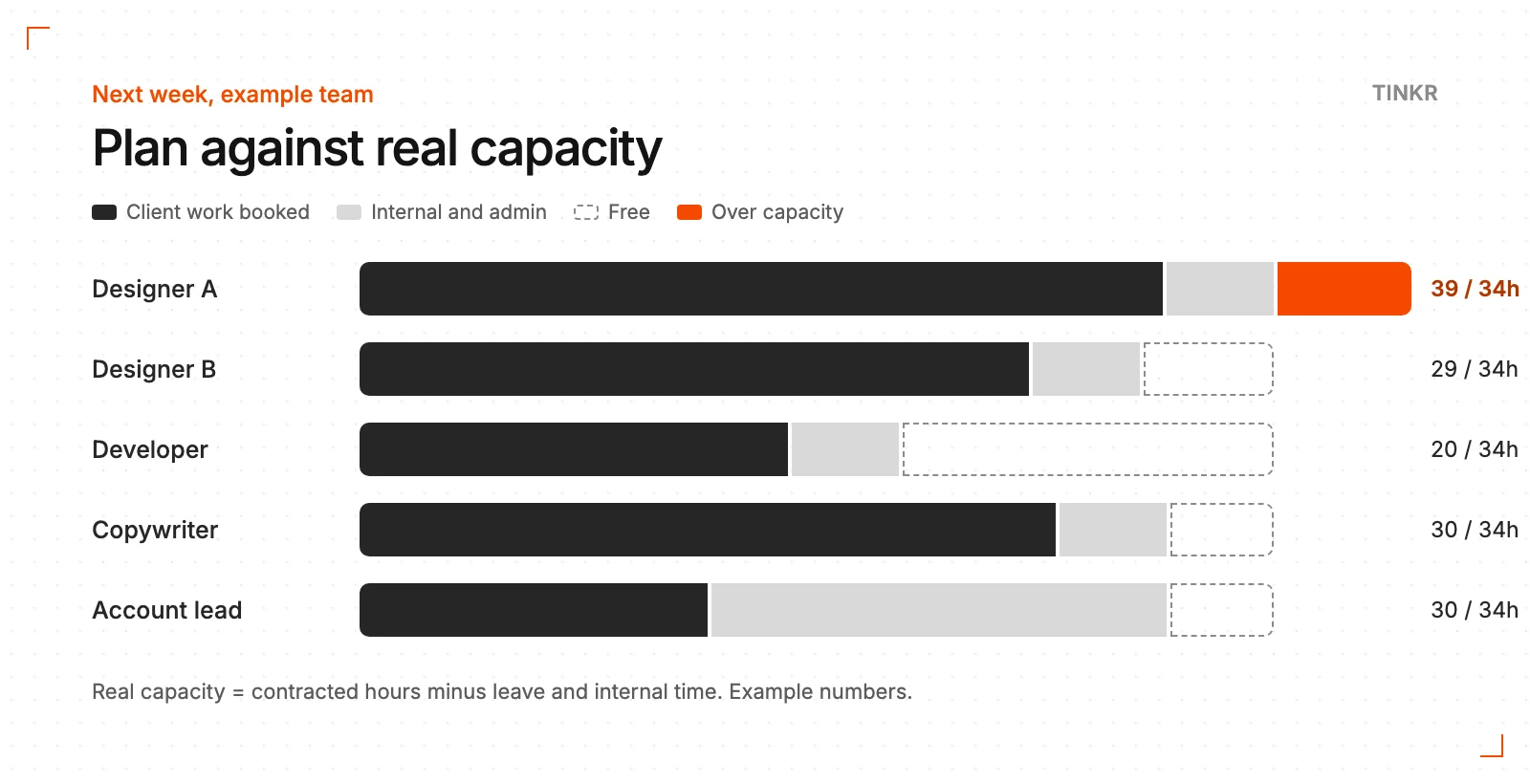
A person contracted for 40 hours doesn't have 40 hours for client work. Subtract leave, internal meetings and the admin that every role carries. What's left is real capacity, and it's usually far lower than people assume.
Step 2: Book people to about 80% of real capacity
Leave room for the work you can't see yet: revisions, client calls, the urgent request that always arrives on Wednesday. Booking to roughly 80% of real capacity is our rule of thumb. Booking to 100% guarantees something slips.
Step 3: Run a 30-minute planning meeting every week
- 1Same time every week, ideally Thursday or Friday for the week after.
- 2Look at next week's bookings per person. Anyone above capacity? Anyone with nothing booked?
- 3Check incoming work: signed projects, likely change requests, briefs still waiting on the client.
- 4Decide, don't discuss. Move work, push a deadline, or bring in a freelancer, and write it down.
- 5Tell the client early if a date has to move. A week's notice is a conversation; a day's notice is a complaint.
Step 4: Keep one source of truth
Capacity planning falls apart when bookings live in a spreadsheet, tasks in the project tool and leave in a shared calendar. Pick one place. Productive, Teamwork, Float and Harvest Forecast are built for it; ClickUp, Monday.com and Asana have workload views on higher plans. The tool matters less than the rule that if it isn't booked there, it isn't booked. Not sure which tool? See the best project management software for agencies.
Signs the system is working
- Nobody finds out on Monday that they're double-booked.
- Utilisation per person stays inside its target range. See utilisation benchmarks by role.
- Fewer deadlines move, and the ones that do move with notice.
- The founder stops being the person who knows who's free.
That last one is the real goal. If every staffing question still comes to you, read how to step back from your agency's day-to-day.
— Paul
Want this looked at in your own company?
A free 30-minute call about how work, data and approvals move through your company today.