AI for Agencies: What to Automate First (and What to Leave Alone)
Most AI projects in agencies start in the wrong place. Start with the plumbing, use AI only where language or judgment is involved, and keep people on everything that carries taste.
 Paul · · 5 min read

Most agencies start with AI in the wrong place.
They start where it's visible: a chatbot on the website, AI-written social posts, a tool that generates moodboards. Then six months later nobody can point to what changed in the numbers.
Start where the work is repetitive and nobody sees it: client onboarding, time and reporting, follow-ups, intake and proposal drafts. Use plain automation for anything rule-based, use AI only where language or judgment is involved, and keep people on everything that carries taste, relationships or a high-stakes decision.
I. Most AI projects fail for organisational reasons, not technical ones
MIT's NANDA initiative studied generative AI in business through 150 interviews with leaders, a survey of 350 employees and an analysis of 300 public deployments. As Fortune reported, only about 5% of AI pilots achieved rapid revenue acceleration; most stalled with little measurable impact on the P&L.
Two other findings matter more for an agency. More than half of generative AI budgets went to sales and marketing tools, while the biggest returns came from back-office automation. And projects bought from specialised vendors or built with partners succeeded about 67% of the time, against roughly a third of that for purely internal builds.
The visible AI projects are rarely the ones that move the numbers.
II. Use a simple rule: plumbing first, AI where language is
"The first rule of any technology used in a business is that automation applied to an efficient operation will magnify the efficiency. The second is that automation applied to an inefficient operation will magnify the inefficiency."
— Bill Gates, The Road Ahead
Most failed AI projects put a model where an integration belonged. If a signed proposal should create a project, that's a rule. It should run the same way every time, and a plain workflow connection does it more reliably and more cheaply than any model.
AI belongs where the input is messy language: an email that might be a new request, a call that needs to become structured notes, a proposal that should borrow from your last twenty. Even there, a person stays in the loop for anything that leaves the building.
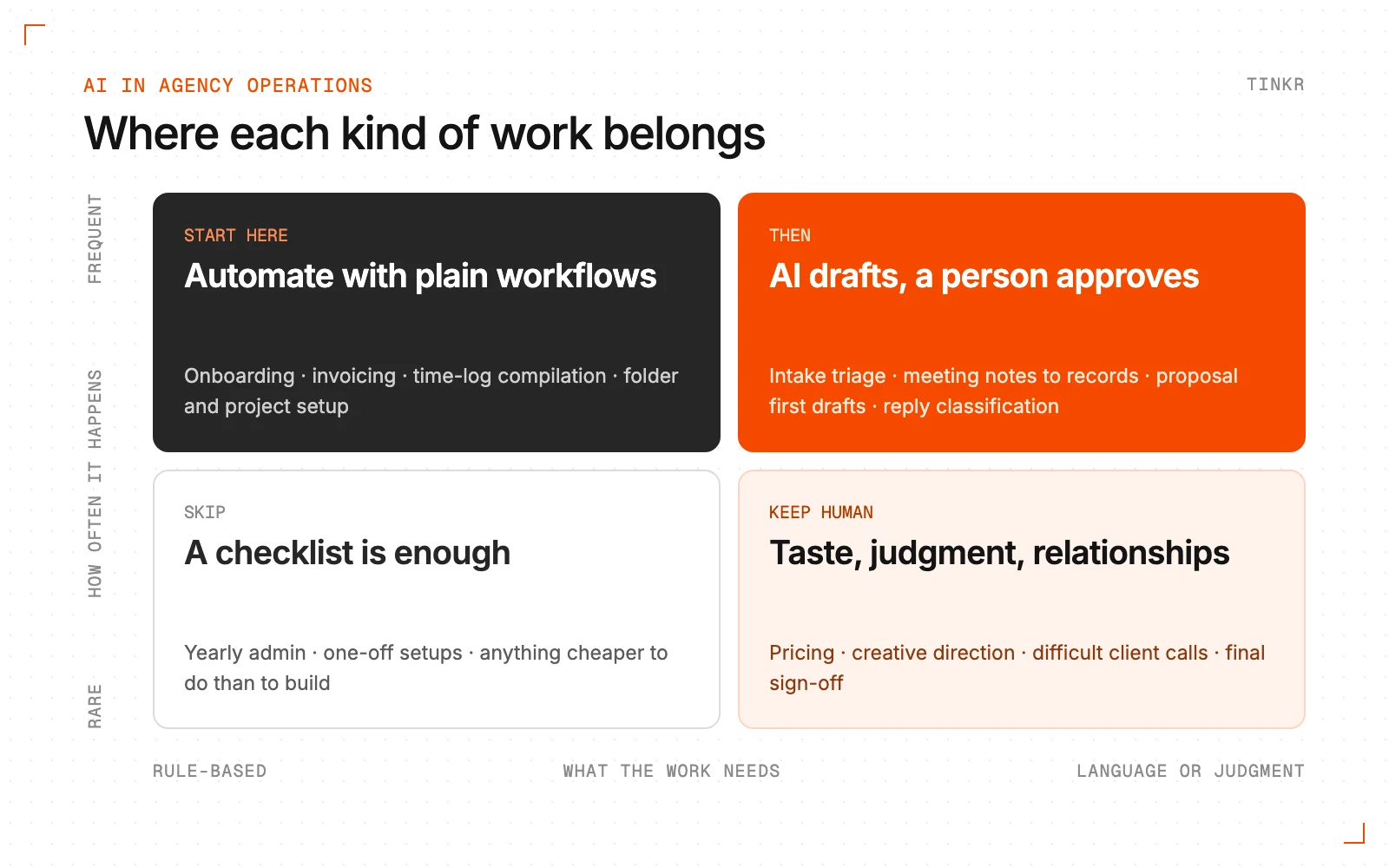
III. Five things to automate first
1. Client onboarding
At JUNO Creative, a design agency in Melbourne, time lived in Harvest, tasks in Monday.com and documentation in Notion, and every new client was set up by hand in all of them. We consolidated onto three integrated tools. Now an accepted proposal creates the project and tasks in ClickUp, generates the folder structure in Dropbox and sends the client their links, with invoicing tied into Xero. The result was ten hours saved every week and onboarding 40% faster. No AI involved, just plumbing.
2. Time and reporting
At Bandit Studio, weekly time logs were compiled by hand and revenue lived in a separate sheet. Automating the compilation and joining the two into one view removed about two hours of manual work a week, and an AI assistant over the agency's own data let the team ask questions of it directly.
3. Follow-ups and chasing
At Gregory Mark Mgmt., one person's whole job was sending follow-up emails to hundreds of leads and clients from a spreadsheet. We replaced it with a Notion database, an automated follow-up sequence, and AI that classifies the replies and routes them to the next stage. That removed around $30,000 a year of manual follow-up cost, and went from start to fully deployed in 35 days.
4. Intake triage
Every inbound email and form classified by type and urgency and routed to a named owner, so the founder's inbox stops being the default queue. Classification is a language task, so AI drafts it and the rules route it.
5. Proposal first drafts
A first draft built from your own past proposals and the notes from the discovery call. The model saves the blank page; the person who knows the client writes the version that gets sent.
IV. What to leave alone
- Autonomous agents doing client-facing work unsupervised. When they fail, the client sees it, and that trust doesn't come back.
- Final deliverables with no named human reviewer. If nobody signs off, nobody is accountable.
- A website chatbot as your first project. It's what almost everyone asks for first, and in my experience it's the most visible and lowest-return item on the list.
V. The real risk is enthusiasm, not caution
One design-studio founder I worked with in Barcelona discovered Claude Code and spent weeks staying up until midnight building tools for his team. In our monthly check-ins he'd show me everything he'd made. It was impressive. None of it produced clear returns, because the builds were either overcomplicated or didn't touch a real problem at the core of the business.
The tools are good enough now that building isn't the hard part. Choosing is. Map where the hours actually go, pick the constraint that costs the most, and fix that one first, with the simplest technology that will do it.
AI should create more room for your best people, not less need for them.
If you want help choosing, our two-week Diagnostic maps where your agency's time goes and ranks what to automate first. Or take the free Leverage Brief and we'll look at it before we talk.
— Paul
Want this looked at in your own agency?
A free 30-minute call about how work, data and approvals move through your agency today.