Do You Need an Operations Manager in Your Agency?
Most agencies hire an operations manager to absorb chaos the systems should prevent. Here's when the hire makes sense, what the role should own, and what to fix first.
 Paul · · 3 min read

An agency needs an operations manager when there's real operational work to own (resourcing, process, tools, onboarding, reporting) and that work is repeatable enough for one person to run. If the role would mostly exist to chase approvals, re-type data and answer "where is this?", fix those systems first. Otherwise you hire someone to be the new bottleneck.
The question usually comes up when the founder realises they've quietly become the operations department.
Signs you've outgrown doing it yourself
- You're the only person who knows who's free next week.
- New clients get set up differently every time, depending on who does it.
- Nobody can say whether last month's projects made money until the accountant closes the books.
- You spend more of your week routing questions than doing the work only you can do.
If that sounds familiar, the first step isn't a hire. It's mapping what still passes through you.
What an operations manager should own
| Area | They own | Systems should handle |
|---|---|---|
| Resourcing | The weekly plan and the trade-offs | Capacity and bookings in one tool |
| Process | How work moves, and changing it | Templates, statuses and handoffs |
| Client onboarding | Exceptions and the first impression | Contract, folders, project setup and kickoff |
| Reporting | What the numbers mean and what to do | Time against budget and margin per project |
| Tools | Which tools stay and how they connect | Data moving once, without re-typing |
A good operations manager owns decisions. A struggling one spends the week doing what software should do.
Three ways to cover operations
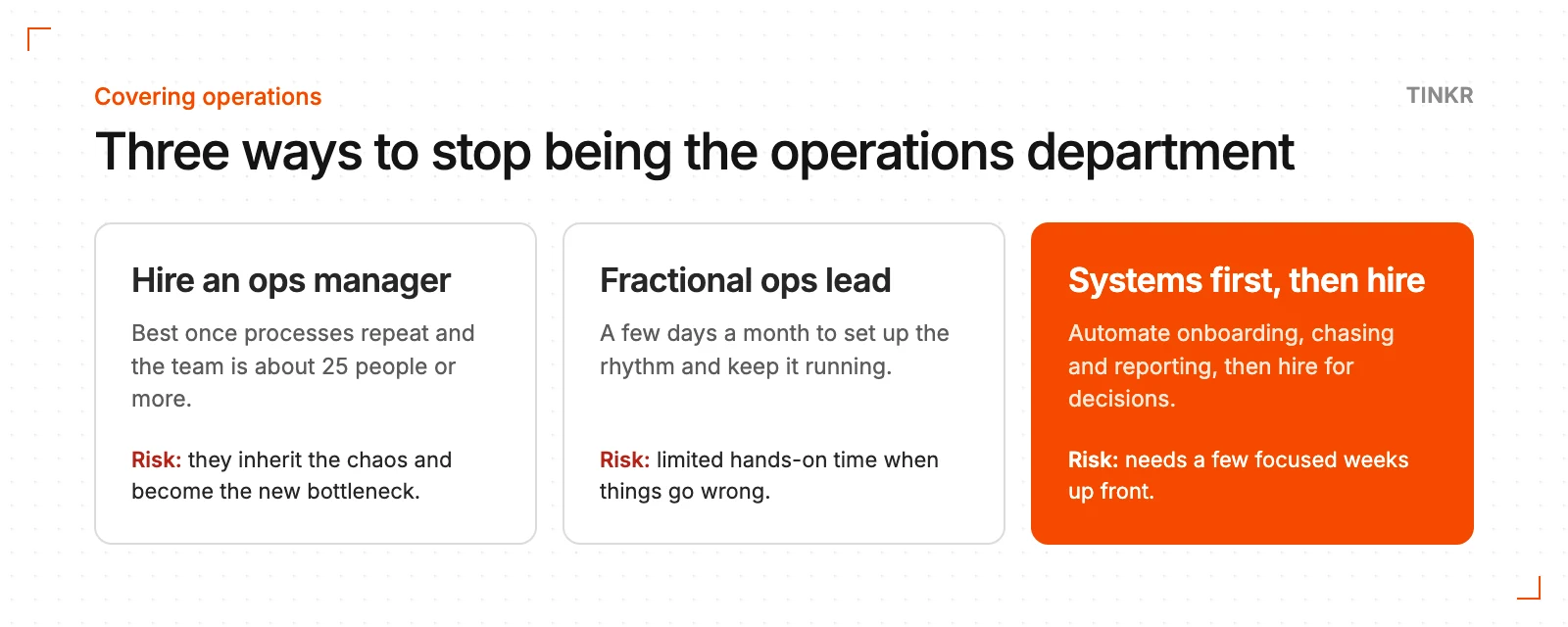
What to automate before you hire
- 1Client onboarding. A signed proposal should create the project, folders and kickoff on its own. At JUNO Creative this made onboarding 40% faster and saved ten hours a week.
- 2Chasing and follow-ups. At Gregory Mark Mgmt., one person's whole job was follow-up emails from a spreadsheet. A system now chases, sorts replies and routes them on, which removed about $30,000 a year of manual cost.
- 3Time and margin reporting, so the numbers are there without someone compiling them.
- 4Approval rules, written down, so small decisions stop queuing for the founder.
We wrote more on this in 7 problems to fix before hiring another project manager.
If you do hire
Hire after the repetitive work is gone, so the role starts on decisions instead of admin. Give them ownership of the weekly planning meeting from day one, a short list of numbers they're accountable for, and the authority to change process without asking permission each time.
Not sure which path fits? The free agency test takes ten minutes, and we'll tell you honestly whether you need a hire, a system, or both.
— Paul
Want this looked at in your own company?
A free 30-minute call about how work, data and approvals move through your company today.