Agency Utilisation Rate vs Realisation Rate: How to Calculate Both
Utilisation tells you how busy your team is. Realisation tells you how much of that work you actually got paid for. Most agencies only measure the first.
 Paul · · 4 min read

Your team can be fully booked and your agency can still be losing money. Utilisation won't tell you. Realisation will.
Utilisation rate is the share of your team's available hours spent on client work: billable hours divided by available hours. Realisation rate is the share of that client work you actually got paid for: what you billed divided by the value of the hours you worked, at your standard rates.
A healthy agency watches both. Most only watch the first, which is how a busy, profitable-looking quarter turns into a disappointing year.
I. How to calculate utilisation (also spelled utilization)
Utilisation = billable hours ÷ available hours
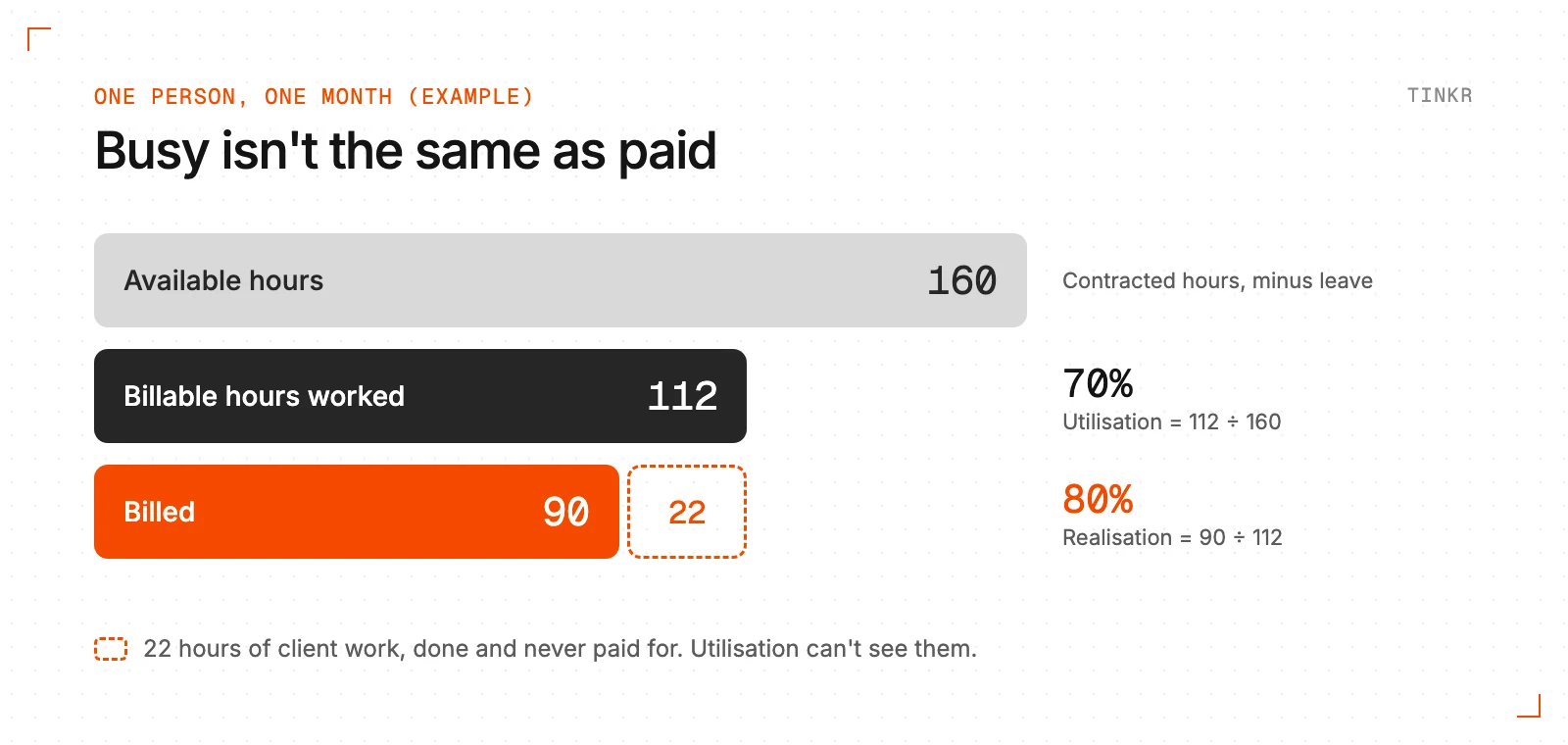
Available hours are the hours a person is contracted for, minus holidays and leave. If someone works 160 hours in a month, and 112 of them were on client work, their utilisation is 70%.
What's good? In SPI Research's 2025 Professional Services Maturity Benchmark, drawn from 403 firms including marketing and advertising agencies, average billable utilisation was 68.9%, below the 75% that SPI treats as optimal.
Targets should differ by role. Designers and developers carry the highest targets. An account lead who spends half their week on client relationships and coordination will be lower, and that's fine. A founder close to 100% isn't a success story; it means nobody is running the business.
II. How to calculate realisation
Realisation = amount billed ÷ (hours worked × standard rate)
If your team logged 112 hours on a project at a standard rate of €100, the work was worth €11,200. If you invoiced €9,000, your realisation on that project is 80%. The other 20% was worked and not paid for.
You can also calculate it in hours: hours billed divided by hours worked. On fixed-fee work, compare the fee with the hours the project actually took at your standard rate.
III. Why high utilisation can hide losses
Utilisation counts effort. It doesn't care whether the effort was paid for.
A team can hit 80% utilisation while the agency over-services every retainer, delivers unbilled revisions and runs projects over their fee. Everyone is busy, the resourcing sheet is full, and the margin still shrinks. That's why so many founders feel the business is working harder every year without earning more.
Utilisation tells you whether people are working on clients. Realisation tells you whether clients are paying for the work.
In our Diagnostics, we pull twelve months of time entries against invoices, project by project. The realisation number that comes out is usually lower than the partners expected. Looking at it per client and per project type shows where the gap sits, and that's what makes it fixable.
IV. Where realisation goes missing
- Scope changes delivered and never invoiced. The biggest one in most agencies. See how to stop scope creep.
- Fixed fees quoted from memory instead of data. If nobody knows what the last five similar projects actually took, the next quote is a guess.
- Write-offs nobody records a reason for. If you write hours off, log why. After three months the reasons tell you exactly what to fix.
- Time entered late. Hours logged on Friday from memory under-record small tasks, so your data says projects were cheaper than they were.
V. How to raise realisation without working more
- 1Measure it per project and per client, not just overall. An agency-wide average hides the two clients who are costing you.
- 2Capture time as work happens. Reminders, timers inside the project tool, or a short daily check-in beat a Friday reconstruction.
- 3Price scope changes before they're done. A change request with a number on it, approved by the client, then scheduled.
- 4Quote fixed fees from your own history. Every finished project should update what you know about how long that kind of work takes.
- 5Review it monthly. One page: realisation by client, the biggest gaps, one change for next month.
At Bandit Studio, the first step was simply putting time delivered and revenue billed side by side, in one view, for the first time. Until those two numbers meet, realisation is something you feel rather than measure.
If you'd like to know your number, our two-week Diagnostic calculates realisation from your own data and shows where it's lost. Or start with the free Leverage Brief.
— Paul
Want this looked at in your own agency?
A free 30-minute call about how work, data and approvals move through your agency today.