How to Stop Scope Creep in Your Agency (Without Awkward Client Conversations)
Scope creep isn't a client problem or a courage problem. It's a system problem: nobody can tell, at the moment of the request, what's in scope and what it costs.
 Paul · · 4 min read

Almost every agency loses money to scope creep, and almost none of them decided to.
Ignition's 2025 Agency Pricing & Cash Flow Report surveyed more than 270 US agency leaders. Nearly 80% said they rarely or only sometimes charge for work outside the original scope. More than half estimated losing $1,000 to $5,000 a month to it; 30% said more than $5,000.
To stop scope creep, make out-of-scope work visible and priced at the moment it's requested, not at the end of the month. That means five things: define scope in units people can check, log every request in one place, classify each one as in or out within a day, price out-of-scope work from a rate card the client already agreed to, and only schedule it once it's approved.
I. Scope creep is a system problem, not a client problem
Clients don't usually push scope on purpose. They ask for things. Whether the answer is "yes, included" or "yes, that's extra" depends on someone on your side knowing, in that moment, what was agreed.
In most agencies, that knowledge sits in a proposal PDF nobody reopens and in the head of whoever sold the project. The designer who receives the request on a call can't price it, doesn't want to be awkward, and does it. Multiply that by every person and every client and you get the Ignition numbers.
The person who receives a request is rarely the person who can price it. Scope creep lives in that gap.
II. Define scope in units someone can check
"Website redesign" can't be checked. "Up to 8 page templates, 2 rounds of revisions per template, copy supplied by the client" can.
Write every proposal so that a person who wasn't in the sales conversation could answer "is this included?" in under a minute. Units, rounds, deliverables, and an explicit list of what's not included. For retainers, define a monthly allowance (hours, deliverables or requests) and what happens when it's exceeded.
III. Run every request through the same five steps
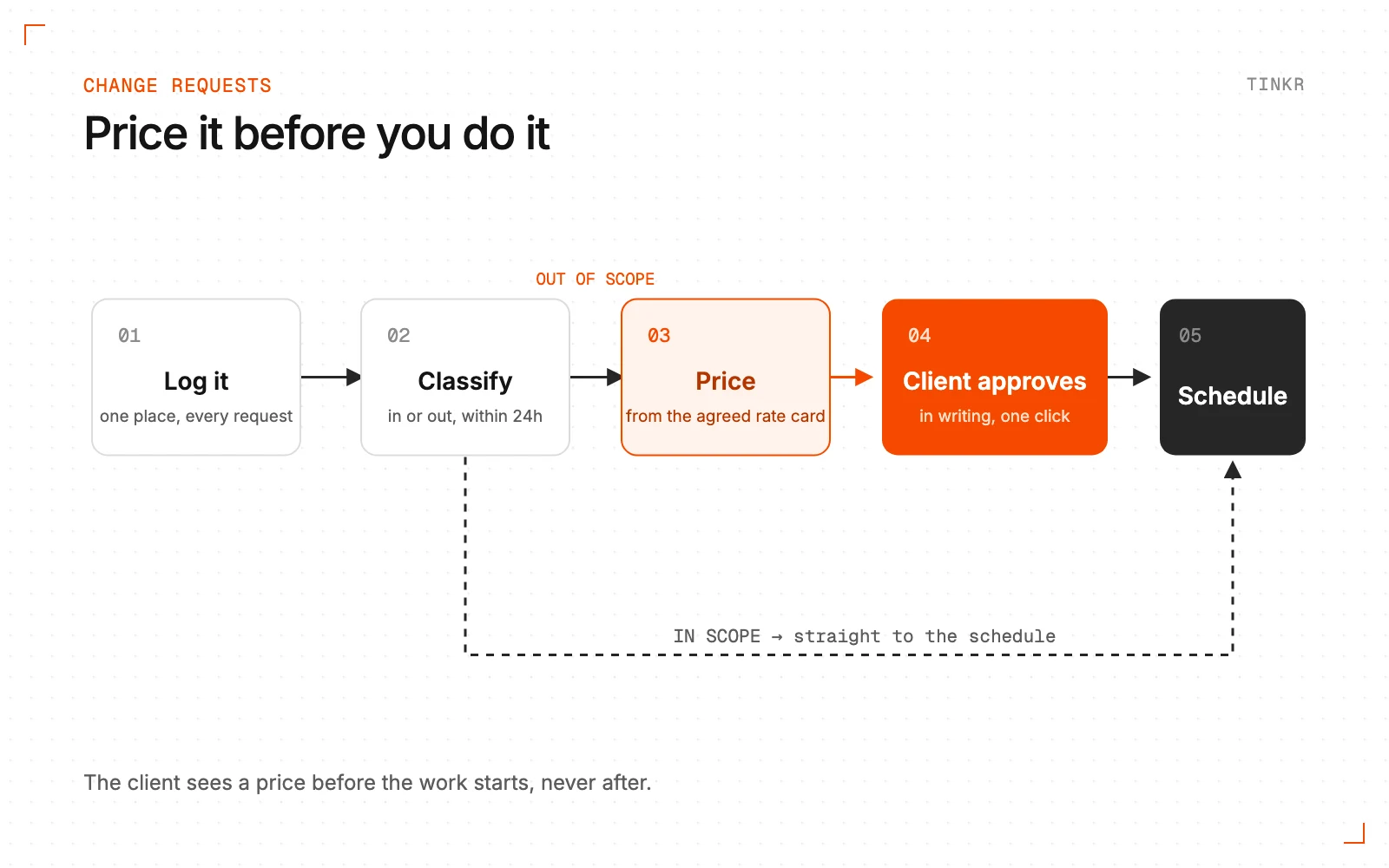
- 1Log it. Every request, from email, calls or Slack, goes into one place, attached to the client and project. If it isn't logged, it doesn't get done.
- 2Classify it within 24 hours. In scope or out of scope, checked against the written scope. Small and clear-cut requests can be classified by the account lead; borderline ones go to whoever owns pricing.
- 3Price it. Out-of-scope work gets a number from a rate card the client agreed to at the start, so the price isn't a negotiation.
- 4Get approval. The client approves the change in writing, ideally with one click.
- 5Schedule it. Only now does it enter the team's workload.
The awkward conversation disappears because it happens once, at the start of the relationship, when you agree on the rate card. After that, a priced change request is just information.
IV. Make it the system's job, not the account lead's courage
Most advice on scope creep is about confidence: learn to say no, have the hard conversation. That works for the founder. It doesn't scale to a team of twenty, where the people receiving requests are junior and want to be helpful.
So take the decision out of their hands. A request form or shared inbox that creates a ticket. A written threshold: anything under an agreed size is absorbed and logged; anything over it becomes a change request automatically. A weekly list of out-of-scope requests that goes to whoever owns the client relationship.
This is also one of the few places where AI earns its keep in an agency's operations. Reading an email and deciding whether it's a new request, which project it belongs to and roughly how big it is, is a language task. A model can draft that classification for a person to confirm. The pricing and the approval stay with people.
V. Retainers need an allowance and an overage rule
Retainers are where scope creep hides best, because there's no end date to reconcile against. Each month absorbs a bit more, and after a year the client is getting a different service for the same fee.
- Set a monthly allowance in hours, deliverables or requests, and show the client how much they've used.
- Agree on the overage rule up front. Extra work is billed at the rate card, or rolls into next month's allowance, or triggers a review of the retainer.
- Review usage quarterly. If a client is over every month, the retainer is underpriced, not the client difficult.
VI. Measure what you recover
Track two numbers each month: how many out-of-scope requests were logged, and how much of that was billed. The first tells you the process is being used; the second is margin you used to give away.
Within a quarter you'll know how much out-of-scope work you were really doing, which is usually the number that makes the case for keeping the process.
We've written about this pattern in more detail on how unbilled scope changes cost agencies their margin. If you'd like to know what it's costing you, the free Leverage Brief is a good place to start.
— Paul
Want this looked at in your own agency?
A free 30-minute call about how work, data and approvals move through your agency today.