What Is a Good Profit Margin for an Agency? Benchmarks, and Where Yours Leaks
The benchmark most agency advisers use is 20% profit on adjusted gross income. Most agencies sit well below it. Here's why, and where the margin goes.
 Paul · · 5 min read

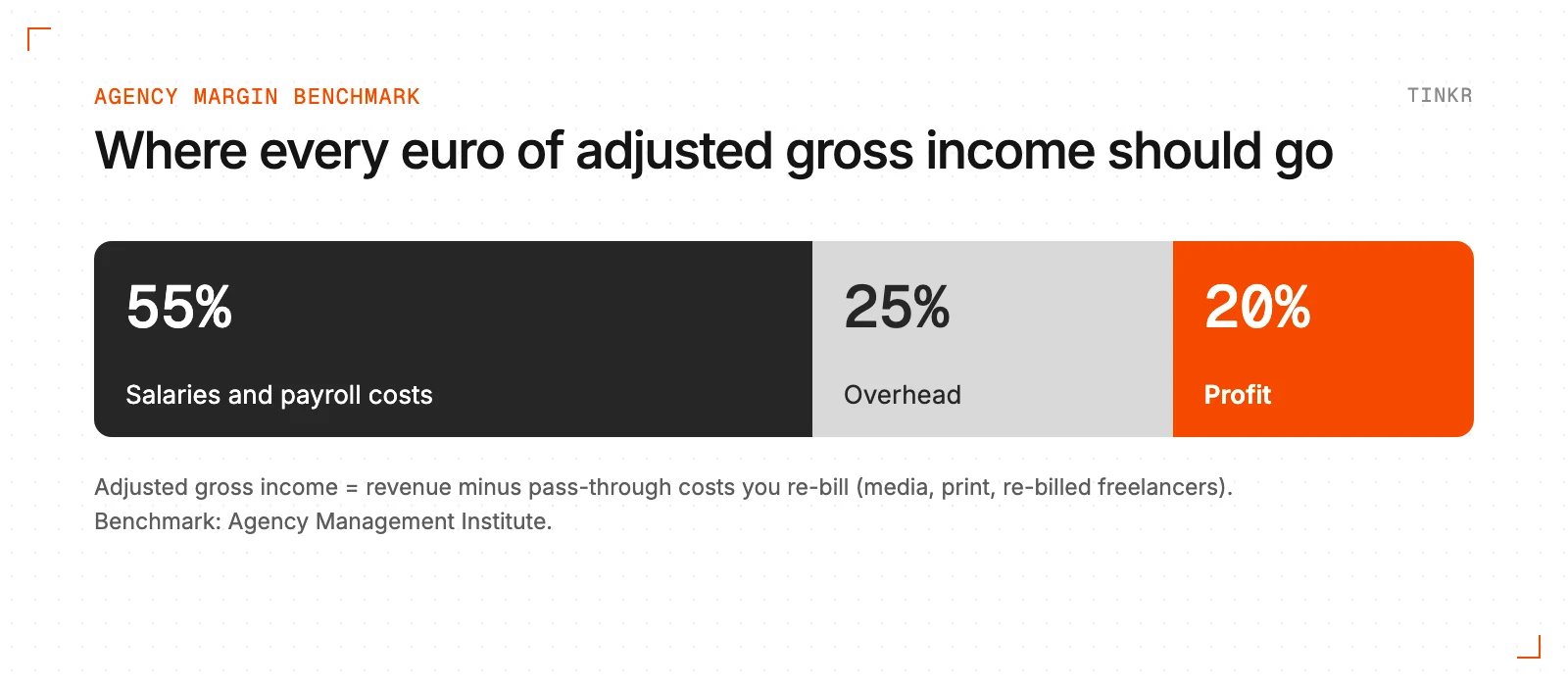
A good profit margin for an agency is around 20% of adjusted gross income.
That's the benchmark the Agency Management Institute teaches: of the money that's really yours (revenue minus pass-through costs like media spend, printing or freelancers you re-bill), roughly 55% goes to salaries and payroll costs, 25% to overhead, and 20% is left as profit.
Most agencies aren't close. In Productive's 2025 Agency Industry Report, a survey of 93 agency leaders, fewer than half of agencies were operating above a 10% margin, and nearly one in five couldn't report their margin at all.
So the useful question isn't what a good margin is. It's why yours is lower, and where it's going.
I. Growing revenue doesn't fix margin. It usually hides the problem.
The same Productive report found that 59% of agencies grew revenue in the past year, but only 31% improved their margins.
That gap makes sense once you see how most agencies grow. More clients bring more hires, more hires bring more coordination, coordination brings more management and more meetings. Revenue goes up. So does the cost of every project, quietly, because more of each hour is spent moving information around instead of doing the work.
When complexity grows faster than output, revenue growth and margin growth come apart.
II. Margin leaks in four places before it ever reaches your P&L
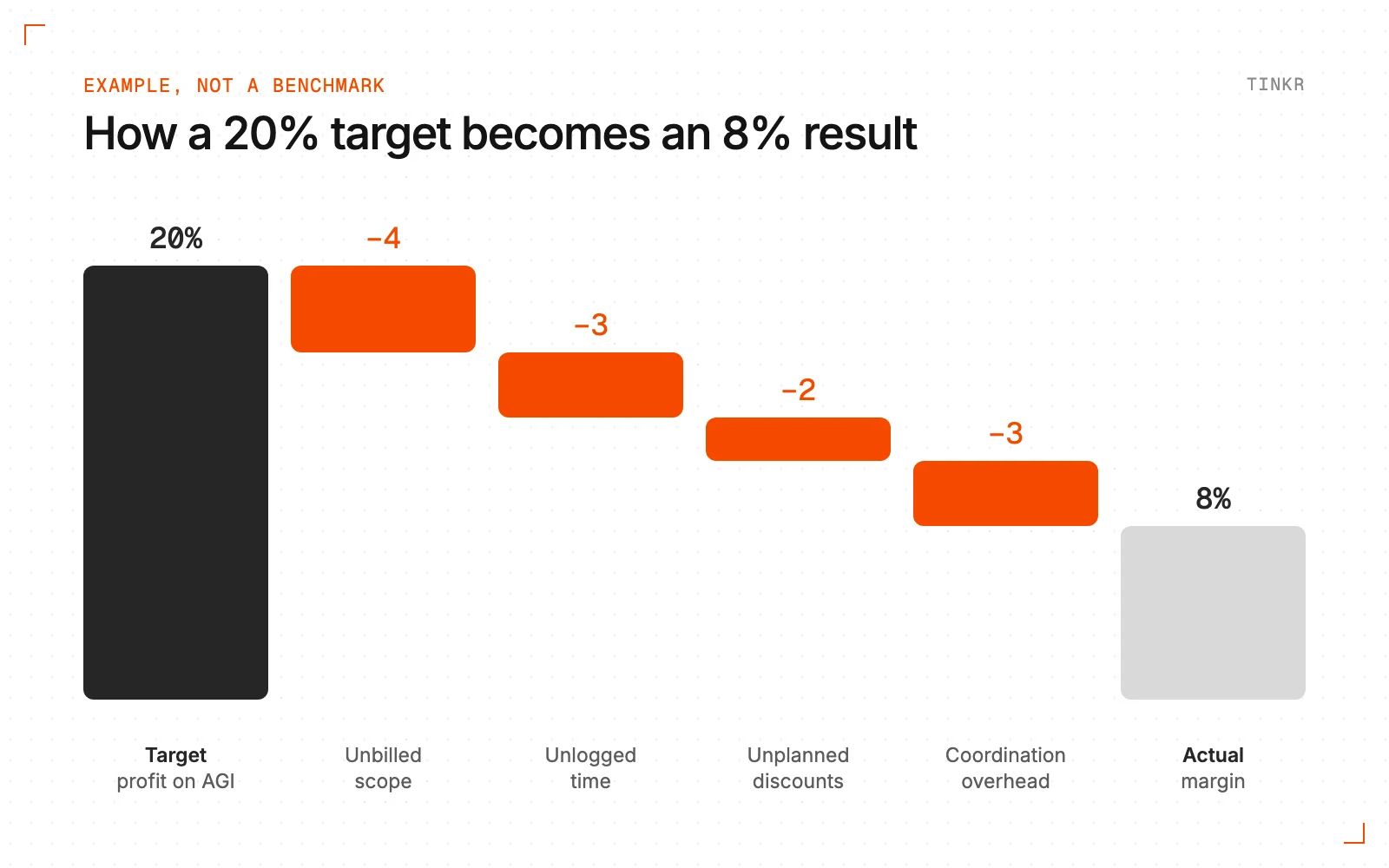
By the time you see a disappointing margin in your accounts, the money left months earlier, in small amounts, in places nobody was watching. These are the four I find most often.
1. Unbilled scope changes
Ignition's 2025 Agency Pricing & Cash Flow Report surveyed more than 270 US agency leaders. Nearly 80% said they rarely or only sometimes charge for work outside the original scope. More than half estimated they lose $1,000 to $5,000 a month to it, and 30% said more than $5,000.
2. Time that's worked but never logged
When time is entered on Friday from memory, small tasks vanish: the quick revision, the call that ran over, the evening fix. You can't bill what isn't recorded, and you can't price the next project correctly from data that's missing a slice of every week.
3. Discounts nobody decided on
Not formal discounts. The extra round of revisions "to keep them happy", the project that was quoted low to win it, the retainer that quietly absorbed more each month. Each was a reasonable call in the moment. Together they're a pricing policy nobody wrote.
4. Coordination overhead
The hours spent chasing approvals, re-typing data from one tool into another, compiling reports by hand and answering "where is this?". None of it is billable, all of it is paid for, and it grows with every person you add.
III. You can't manage a number you can only see once a quarter
The one-in-five agencies that can't report their margin aren't careless. Usually the data exists, but it lives in two places that never meet: time and tasks in the project tool, revenue in the accounting system or a spreadsheet.
That was the situation at Bandit Studio, a brand experience agency in Sydney. Designer time lived in Monday.com; revenue lived in a Google Sheet shared with the accountant. Nobody could see the two side by side without an evening of copying. We joined them into one operating and financial view and automated the weekly time-log compilation, which removed about two hours of manual work every week. More importantly, decisions about growth started from the agency's actual numbers.
Margin isn't an accounting number. It's an operating number that accounting reports late.
IV. How to find your real margin in an afternoon
You don't need a consultant to get a first read. You need twelve months of data and a spreadsheet.
- 1Work out adjusted gross income. Total revenue minus pass-through costs you re-bill to clients.
- 2Split your costs into the three buckets. Salaries and payroll costs (including the founders' fair market salary), overhead, and what's left.
- 3Divide each bucket by AGI. Compare to 55 / 25 / 20. If payroll is well above 55%, you're either underpriced or carrying unbillable work.
- 4Pull time against invoices, by project. For your ten biggest projects, compare hours worked with what you billed. The gap is where the leak lives.
- 5Name the leak. Is the gap scope changes, unlogged time, discounting or coordination? Usually one dominates.
V. What actually moves margin
Raising prices helps, and most agencies say they plan to: 97% in the Ignition survey. But a price rise applied to a leaky operation just leaks at a higher rate.
The changes that move margin fastest are the ones that stop the leaks above: a change-request process so out-of-scope work gets priced before it's done (we wrote a full guide to stopping scope creep), time captured as work happens, written approval thresholds for discounts, and tools connected so data moves once instead of being re-keyed.
None of these are glamorous. All of them are cheaper than another hire.
If you want the number measured properly, our Diagnostic pulls twelve months of time entries against invoices and shows where the gap is, project by project. Or start with the free Leverage Brief: ten minutes, and we read it before we talk.
— Paul
Want this looked at in your own agency?
A free 30-minute call about how work, data and approvals move through your agency today.